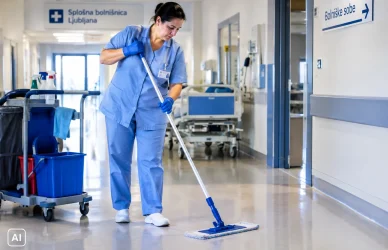


A ward attendant in healthcare (in Slovenian: strežnica / strežnik v zdravstvu) does support work in healthcare institutions and looks after the tidiness and cleanliness of the patient’s surroundings, clinics, waiting rooms and other premises. Depending on the post, the work may also include preparing and changing linen, delivering supplies, arranging the patient’s surroundings and other auxiliary tasks.
The official title of the post in the Slovenian public healthcare system is STREŽNICA V ZDRAVSTVU (ward attendant in healthcare). The post has the code E042001 and is placed in tariff class II. Current rules place it in pay subgroup E4 – healthcare workers and healthcare associates.
In everyday speech the job is also called hospital attendant or orderly, but when describing a specific post it is important to use the title the employer uses.
Ward attendant in healthcare – a short description of the job
A ward attendant in healthcare does support work in a healthcare institution. They keep the patient’s surroundings, clinics and waiting rooms tidy and clean, and may also handle tasks related to bed linen, supplies, delivering food and drinks, and arranging equipment. For any specific post, the employer’s requirements and the institution’s instructions are what matter.
What does a ward attendant in healthcare do?
The work is mainly about arranging the patient’s surroundings and various support tasks in a healthcare institution. Tasks may include:
- arranging and cleaning the patient’s surroundings,
- cleaning and tidying clinics,
- cleaning and tidying waiting rooms,
- tidying patient rooms,
- preparing and changing bed linen,
- sorting and removing soiled linen,
- delivering clean linen and clothing,
- delivering supplies to wards or rooms,
- keeping equipment and aids in order,
- cleaning and disinfecting equipment and aids in line with instructions,
- making the patient’s bed and tidying around it,
- preparing a room for admitting or discharging a patient,
- delivering food and drinks,
- helping with eating or drinking, where this is part of the post and the institution’s instructions,
- other auxiliary tasks as instructed by the person in charge.
The exact scope of tasks varies with the institution, the ward and how the post is defined.
Official title: ward attendant in healthcare
Current regulations on posts in healthcare list the post STREŽNICA V ZDRAVSTVU with the code E042001. There is also the post STREŽNICA V ZDRAVSTVU S POSEBNIMI ZNANJI – ward attendant in healthcare with special skills (E042003).
The ward attendant with special skills works in certain more demanding areas, including intensive care III, emergency services, areas with ionising radiation and pathology or forensic medicine.
What is the difference between a ward attendant and a cleaner in healthcare?
A ward attendant and a cleaner in healthcare are not necessarily the same post.
- A cleaner in healthcare focuses mainly on cleaning and maintaining the premises.
- A ward attendant in healthcare may have a wider range of support tasks related to the patient’s surroundings, bed linen, supplies, food and arranging the room.
Official regulations, for example, explicitly mention arranging and cleaning the patient’s surroundings, clinics and waiting rooms for the ward attendant.
So when looking for a job, the title alone is not enough. Always check the description of duties in the specific advert.
→ Cleaner in healthcare: job description
Is a ward attendant in healthcare a healthcare worker?
The title is placed in pay subgroup E4 – healthcare workers and healthcare associates, but a ward attendant does not provide nursing care in the way a nurse or healthcare technician does.
It is support work within healthcare. A ward attendant therefore does not make diagnoses, does not prescribe treatment and does not provide nursing care that would require the relevant professional healthcare education.
Is the job regulated?
The ward attendant in healthcare is defined in current regulations as a specific post in healthcare, but this does not mean it is a regulated healthcare profession with the same conditions as a doctor, a nurse or other regulated healthcare professions.
What matters for employment are mainly the requirements set out in the specific advert or in how the post is defined.
What education is required?
The official classification places the post STREŽNICA V ZDRAVSTVU in tariff class II.
This means that, as a rule, the post itself does not require higher or secondary healthcare education of the kind needed for a healthcare technician or a nurse.
An employer may set additional requirements in the advert, so always check the current advert.
Is a healthcare school needed?
As a rule, the job does not require education as a healthcare technician or nurse.
It is important, however, to be trained for work in a healthcare environment and to know:
- hygiene procedures,
- safe working rules,
- how to use protective equipment correctly,
- how to handle linen,
- how to handle waste,
- cleaning and disinfection procedures,
- privacy rules,
- the instructions of the specific ward or institution.
Is the professional examination for healthcare workers required?
The conditions for a ward attendant in healthcare cannot automatically be equated with those for regulated healthcare professions.
Unless the specific advert says otherwise, the professional examination prescribed for individual regulated healthcare professions is not a condition for the support post of ward attendant. Always check the requirements of the specific post.
Ward attendant in a hospital
In a hospital, a ward attendant’s work can involve different wards and services. They may look after:
- tidying patient rooms,
- beds,
- the area around the bed,
- linen,
- delivering supplies,
- keeping the premises tidy,
- helping to care for the patient’s surroundings,
- delivering food and drinks,
- other support tasks.
In some posts the tasks are wider and may also include helping with eating or drinking or other tasks, but the specific job description must be followed.
Ward attendant in a community health centre
In a community health centre the tasks may focus more on arranging and cleaning clinics, waiting rooms and other rooms. Current regulations explicitly mention the ward attendant post for arranging and cleaning the patient’s surroundings, clinics and waiting rooms.
Working with patients
A ward attendant often meets patients at work. It is important that they:
- respect the patient,
- respect the patient’s privacy,
- communicate respectfully,
- do not interfere with the tasks of healthcare staff,
- follow the instructions of healthcare staff,
- protect personal and health data.
A ward attendant may be part of the patient’s everyday surroundings, so a professional attitude and discretion are very important.
Do ward attendants help patients eat?
It depends on the specific post.
Some job descriptions include delivering food and drinks, helping with eating, handing out drinks and helping patients drink. Such tasks must be carried out in line with the institution’s instructions and within the scope of the post.
A ward attendant does not take over nursing tasks.
Working with linen
Handling linen can be an important part of the work. It may include:
- preparing clean linen,
- changing bed linen,
- sorting linen,
- delivering linen,
- removing soiled linen,
- handling soiled linen correctly.
Hygiene rules and the institution’s internal instructions must be followed.
Cleaning and disinfecting equipment
A ward attendant may also clean and disinfect certain aids and equipment. Examples include:
- bedside tables,
- beds,
- care trolleys,
- certain aids,
- other equipment around the patient.
Procedures must be carried out in line with the institution’s instructions.
Privacy
Because a ward attendant works directly in patient rooms, clinics and other healthcare premises, they may come across personal data and information about patients’ health. They must therefore be discreet at work.
They must not pass on information about patients to others and must respect the rules on personal data protection and confidentiality.
Where can a ward attendant in healthcare work?
Employment is possible in many healthcare institutions, for example:
- hospitals,
- community health centres,
- specialist clinics,
- private clinics,
- rehabilitation institutions,
- other healthcare institutions.
Similar support work is also done in social care institutions, but the title ward attendant in healthcare should be distinguished from attendant in a social care institution.
→ Ward attendant: current vacancies
→ All vacancies in support services
Finding a job as a ward attendant
Different titles may appear in adverts, so search using several terms:
- ward attendant,
- hospital attendant,
- orderly,
- strežnica v zdravstvu (the Slovenian title),
- strežnik v zdravstvu,
- bolniški strežnik.
In its data, the Employment Service of Slovenia has also used the occupational label “attendant in a healthcare institution” within the broader group of cleaners, ward attendants and housekeeping assistants.
Is the work shift-based?
It can be. The organisation of work depends on the institution and the ward. Hospitals run 24 hours a day, so some posts may include:
- morning work,
- afternoon work,
- night work,
- Saturday work,
- Sunday work,
- work on public holidays.
In other healthcare institutions, working hours may be more in line with the daily schedule of the clinics.
Do ward attendants work at night?
They may, but not in every post. If the post is organised as a continuous or multi-shift process, it may include night work. Always check this in the specific advert.
What qualities does a ward attendant need?
Important qualities are:
- reliability,
- accuracy,
- responsibility,
- tidiness,
- cleanliness,
- discretion,
- patience,
- a respectful attitude towards patients,
- teamwork,
- independence,
- physical stamina,
- willingness to work shifts.
The ability to follow instructions is also important, as work in a healthcare environment is bound up with hygiene and safety requirements.
Is the work physically demanding?
It can be. A ward attendant may spend much of the working day on their feet. The work may involve walking, bending, pushing trolleys, making beds, changing linen and moving various equipment.
How physically demanding it is depends on the ward and the specific tasks.
Personal protective equipment
Protective equipment is used according to the risks and the employer’s instructions. It may include:
- protective gloves,
- protective clothing,
- protective footwear,
- a protective mask,
- other personal protective equipment.
Employees must be familiar with the correct use of the equipment and safe working procedures.
Ward attendants and infection prevention
Although a ward attendant does not provide nursing care, the work takes place in an environment where hygiene is very important. The following must therefore be observed:
- hand hygiene,
- correct cleaning,
- disinfection where prescribed,
- correct handling of linen,
- correct handling of waste,
- preventing cross-contamination,
- the institution’s instructions.
In this way the ward attendant helps keep the environment tidy and safe for patients and staff.
Ward attendant in healthcare with special skills
There is also the official post STREŽNICA V ZDRAVSTVU S POSEBNIMI ZNANJI – ward attendant in healthcare with special skills (E042003). Special criteria apply to this post. The current regulation lists work in:
- intensive care III,
- emergency services,
- areas with ionising radiation,
- pathology or forensic medicine.
This means that not all ward attendant posts are the same.
Ward attendant pay in healthcare
Pay depends on the specific post, the employer, the collective agreement, length of service, allowances and the organisation of work.
In the public sector, the post STREŽNICA V ZDRAVSTVU (E042001) is placed in tariff class II under current rules and has a set starting and final pay grade. Current rules set a starting pay grade of 2 and a final pay grade of 12. For the ward attendant with special skills, the grades are 3 and 13.
A pay grade is not the same as a set net amount. The final pay also depends on other elements of pay and any allowances.
What is the demand for ward attendants?
The Employment Service of Slovenia places the attendant in a healthcare institution in the broader occupational group of cleaners, ward attendants and housekeeping assistants. In its Employment Forecast survey, employers also mentioned the post of attendant in a healthcare institution.
Demand for the specific post varies by region, healthcare institution and current staffing situation.
What does a working day look like?
The working day depends on the ward. It may include:
- taking over the shift,
- checking the working environment,
- preparing the necessary supplies,
- tidying patient rooms,
- making beds and tidying around them,
- handling linen,
- cleaning and disinfecting aids,
- delivering supplies,
- delivering food and drinks,
- other support tasks,
- handing over to the next shift.
Cooperation with healthcare staff and other employees is important.
Attitude towards patients
A ward attendant may be one of the people a patient sees every day. Important therefore are:
- a friendly attitude,
- respectful communication,
- patience,
- discretion,
- understanding that the patient may be frightened, tired or in pain.
At the same time, a ward attendant must know the limits of their role and must not carry out healthcare tasks without the relevant training.
The difference between a ward attendant, a hospital orderly (bolničar – negovalec) and a healthcare technician
Ward attendant in healthcare
Carries out support tasks related to the patient’s surroundings, arranging the room, linen, supplies and other tasks set by the post.
Hospital orderly (bolničar – negovalec)
Carries out tasks related to basic nursing care and support within the scope of their training.
Healthcare technician
Has the relevant healthcare education and provides nursing care and other professional tasks within their competence.
A ward attendant should therefore not be equated with a hospital orderly or a healthcare technician.
→ Hospital orderly: profession guide
→ Nurse – nursing technician: profession guide
Advantages of working as a ward attendant
- employment opportunities in many healthcare institutions,
- work in the stable environment of healthcare,
- varied support tasks,
- teamwork,
- gaining experience in a healthcare environment,
- opportunities for further training,
- the option of working different shifts.
Challenges of the job
- physically demanding tasks,
- a lot of walking and standing,
- working with linen and waste,
- contact with patients,
- work in demanding healthcare settings,
- shift or night work,
- the need to follow hygiene rules consistently,
- emotionally demanding situations.
The future of the job
Healthcare institutions will continue to need support staff who look after the patient’s surroundings and keep daily processes running smoothly.
Technology may automate part of cleaning, transport and logistics, but important tasks remain that require people, adapting to circumstances, communication and cooperation with healthcare staff.
Frequently asked questions
What does a ward attendant in healthcare do?
A ward attendant does various support tasks, including arranging and cleaning the patient’s surroundings, clinics and waiting rooms, and other tasks set by the specific post.
Is a ward attendant a healthcare worker?
It is a post within healthcare, but a ward attendant does not provide nursing care or other professional healthcare tasks in the way a nurse or healthcare technician does.
Do I need a healthcare school?
As a rule, the post does not require education as a healthcare technician or nurse. The specific requirements are set by the employer.
Do I need the professional examination?
It depends on the specific post. A ward attendant cannot automatically be equated with the regulated healthcare professions.
Can a ward attendant work in a hospital?
Yes. The ward attendant in healthcare is an officially defined post in healthcare.
Does a ward attendant help the patient?
They may carry out certain support tasks related to the patient’s surroundings, delivering food and drinks and other tasks, if these are part of their specific post. They do not provide nursing care without the relevant competence and training.
Do ward attendants work at night?
They may. It depends on the organisation of work and the specific ward.
What is a ward attendant’s pay in healthcare?
In the public sector, the post STREŽNICA V ZDRAVSTVU (E042001) is currently placed in a pay grade range set by the applicable pay rules. The actual pay depends on several factors, so it cannot be determined from the title of the post alone.
Where can I look for a job?
On the websites of hospitals, community health centres and other healthcare institutions, the Employment Service of Slovenia portal and job portals.
WARD ATTENDANT JOBS (see current vacancies for ward attendants)
ARE YOU HIRING A WARD ATTENDANT? (see the packages for posting a job advert)
What is a BOOST advert? Read more …
All healthcare and pharmacy professions in one place
Have you found an error in this description, or does it need updating? Please send corrections to: podpora@zdravstvena.info
Sources
- Official Gazette of the Republic of Slovenia – Annex to the Collective Agreement for Healthcare and Social Care in Slovenia, defining the post STREŽNICA V ZDRAVSTVU (E042001) and its classification.
- Official Gazette of the Republic of Slovenia – definition of the ward attendant post for arranging and cleaning the patient’s surroundings, clinics and waiting rooms.
- Official Gazette of the Republic of Slovenia – criteria for the ward attendant in healthcare with special skills (E042003).
- Employment Service of Slovenia – occupational data for the group of cleaners, ward attendants and housekeeping assistants.