

The hospital orderly — in Slovenian »bolničar – negovalec« — is a regulated healthcare profession in Slovenia. The work covers helping people with basic daily activities, nursing care of patients and residents, and working as part of the healthcare team. Employment is possible in hospitals and other healthcare institutions, in social care institutions and care homes for older people, in health resorts and in long-term care. To work independently in healthcare activity, a person needs a suitable qualification, a traineeship, the professional examination and entry in the register. Because the population is ageing and long-term care is being developed, the profession will matter for the future needs of the Slovenian health and social care system.
The profession brings together nursing care, help with everyday activities, care of patients and cooperation with the healthcare team. It matters most in the care of older people, the chronically ill, people who cannot move unaided and anyone else who needs help with the activities of daily life.
The hospital orderly in brief
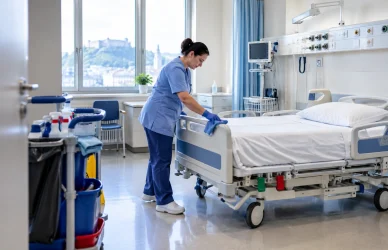
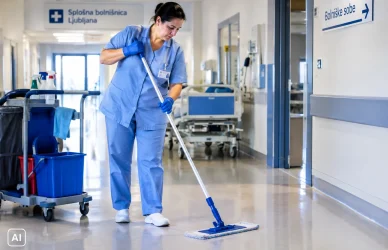
A hospital orderly is a healthcare worker who, within the scope of their competence, takes part in the nursing care of patients and residents and helps them with basic daily activities.
The work can include help with:
- eating and drinking,
- moving about,
- personal hygiene,
- dressing and undressing,
- elimination,
- sleep and rest,
- maintaining body temperature,
- monitoring the state of health,
- care of older people,
- accompanying the dying and caring for the deceased,
- rehabilitation activities,
- recognising injuries and sudden illness,
- communicating with the patient, the family and the healthcare team.
The Slovenian SPOT portal places the profession at the primary, secondary and tertiary level of healthcare activity, and also in social care institutions, special social care institutions, health resorts and certain other services.
What does a hospital orderly do?
The work is very practical and directly connected with the patient or the resident. The official description of the profession includes:
- identifying the needs of residents,
- planning, carrying out and reviewing care procedures within the scope of competence,
- helping with the activities of daily life,
- nursing care for the most common conditions of old age,
- accompanying the dying,
- caring for the deceased,
- documenting and reporting,
- preparing, carrying out and checking their own work together with their supervisors,
- maintaining hygiene of rooms and equipment in areas with demanding hygiene requirements,
- working with healthcare staff on rehabilitation,
- recognising and responding to injuries and sudden illness within the scope of competence,
- encouraging a healthy way of life,
- communicating with patients, colleagues and professional services,
- using modern information technology.
It matters that the hospital orderly works within the competences they have acquired and together with their supervisors and the healthcare team.
Which procedures may a hospital orderly carry out?
The current list of healthcare occupations names specific procedures among the competences of a hospital orderly:
- measuring body temperature,
- measuring blood pressure,
- measuring the pulse,
- fitting compression stockings,
- applying long-stretch compression therapy to the legs,
- helping the patient take pre-prepared medicines according to instructions,
- helping with nursing procedures,
- helping with the activities of daily life.
The key difference between a hospital orderly and a nurse or another healthcare profession lies in the scope of competences and responsibility. A hospital orderly does not replace a nurse; they are an important member of the healthcare and nursing team.
Where can a hospital orderly work?
The options are considerably wider than many people imagine. According to SPOT, a hospital orderly can work in the following areas.
Healthcare
- community health centres,
- hospitals,
- other healthcare institutions,
- primary healthcare activity,
- secondary healthcare activity,
- tertiary healthcare activity.
Social care
- care homes for older people,
- social care institutions,
- special social care institutions,
- institutions for people with special needs.
Other areas
- health resorts,
- long-term care services,
- certain public health services,
- other institutions where help with nursing and care is needed.
Is hospital orderly a regulated profession?
Yes. In Slovenia the profession is listed among the regulated healthcare occupations; the competent authority is the Ministry of Health.
To work independently in healthcare activity, the following matter:
- suitable professional education or a recognised qualification,
- a traineeship,
- the professional examination,
- entry in the appropriate register of healthcare workers.
For this profession, SPOT explicitly requires a traineeship, the professional examination and entry in the register.
What education does a hospital orderly need?
One of the classic routes is upper secondary vocational education for the profession. According to the Slovenian Qualifications Framework this means:
- upper secondary vocational education,
- a vocational programme,
- three years of study,
- 180 credit points,
- entry is possible after completing basic school or short upper secondary vocational education.
Anyone wanting to enter the profession by another route should check the current conditions set by the Ministry of Health — the options for training and for obtaining the qualification are developing.
The new traineeship programme
A particularly important development for this profession is the new traineeship programme that the Ministry of Health began piloting in 2024. It is also intended for candidates who have not completed the classic secondary school programme for this occupation.
The new model consists of:
- two months, or 320 hours, of theoretical training,
- four months of practical work,
- six months of traineeship in total.
Among the conditions for joining the pilot programme were at least level IV education, that is any upper secondary vocational education, and a minimum age of 18. During the traineeship the candidate was employed by a healthcare provider that meets the conditions for running the programme.
The practical part also covers the organisation of work, occupational safety, institutional care of older people, help for individuals and families at home, care of people with dementia, and care of people who need 24-hour supervision.
This is a telling sign of how the profession is developing, since the state links this field to both healthcare and long-term care.
Traineeship and professional examination
According to official information, independent work in healthcare activity requires a completed traineeship and a passed professional examination.
The professional examination for this profession covers, among other things:
- selected topics in emergency medical assistance,
- the basics of safety and quality in healthcare,
- other prescribed content according to the programme and the occupation.
Once the professional examination has been passed, the person is also entered in the register of providers in nursing and midwifery care.
Entry in the register of healthcare workers
The hospital orderly is among the occupations for which entry in the register of providers in nursing and midwifery care is required. SPOT explicitly lists this profession alongside the healthcare technician, the midwife, the registered nurse and other occupations, subject to the applicable conditions.
Evidence of the professional examination and of suitable education is among the documents required for entry.
Does a hospital orderly need a licence?
There is an important distinction here. According to current SPOT information, the healthcare workers who must be entered in the register and hold a valid licence are the registered nurse, the registered midwife and the higher-level nurse or higher healthcare technician.
The hospital orderly is listed among the occupations that must be entered in the register. The rule for this profession is therefore: meet the conditions for practising the occupation, pass the professional examination, and be entered in the appropriate register.
The hospital orderly in a hospital
In a hospital the work can be very varied. A hospital orderly may take part in:
- admitting and settling in patients,
- basic nursing care,
- mobilising patients,
- personal hygiene,
- eating and drinking,
- accompanying patients,
- preparing the patient for certain procedures,
- maintaining hygiene conditions,
- observing the patient,
- documenting,
- working with nurses and other healthcare staff.
The work may be organised in shifts, depending on the institution and the post.
The hospital orderly in a care home
One of the most important employment areas for this profession is the care of older people. The expected demographic changes will increase the importance of staff who can help people with everyday life and with nursing care.
In such a setting a hospital orderly may take part in:
- personal care,
- eating and drinking,
- moving about,
- preventing complications caused by immobility,
- observing the resident,
- communicating with the family,
- caring for people with dementia,
- palliative and supportive care within the scope of their competence,
- working with the healthcare and nursing team.
The hospital orderly and long-term care
Long-term care is one of the main reasons why this profession will stay relevant. The Ministry of Health linked the new traineeship programme to work in both healthcare and long-term care, and presented the programme as a measure to reduce the shortage of this occupation on the labour market.
Employment options are therefore not limited to hospitals. A significant part of future demand may come from hospitals, care homes for older people, long-term care, home help, special social care institutions, rehabilitation and health resorts.
Who is suited to this profession?
Professional knowledge is not the only thing that matters here.
Humanity
Patients often need help with very personal and intimate tasks.
Patience
Working with older people, people with dementia, people who cannot move unaided and the seriously ill calls for a great deal of patience.
Responsibility
Small changes in a patient can matter; they have to be noticed in time and passed on to the healthcare team.
Physical fitness
The work can involve a lot of walking, lifting or moving patients and other physical demands.
Communication
The hospital orderly is often the healthcare worker the patient spends the most time with.
Emotional steadiness
The work also involves illness, old age, loss, dying and contact with families.
Is it a hard profession?
It can be. The work combines:
- physical effort,
- responsibility,
- working with people,
- emotional demands,
- shift work,
- difficult situations in people’s lives.
On the other hand the work can be deeply meaningful, because a hospital orderly often helps a person directly with their basic needs and with the quality of their day. For someone who wants a practical healthcare profession and direct work with people, this can be a serious career option.
How much does a hospital orderly earn?
Pay varies according to the employer, the field of work, the post, length of service, allowances, shift and night work, work on Sundays and public holidays, promotions and the collective agreement.
With public employers, posts for this profession are placed within the public sector pay system. The applicable legal acts define several posts, among them:
- hospital orderly, escort,
- hospital orderly, escort – psychiatry,
- hospital orderly, escort in hospital services,
- hospital orderly in emergency and surgical services and intensive care.
In the system these posts are classified in tariff class IV, while their exact placement differs according to the specific post and the field of work.
Important: a pay grade should not be equated with net pay. Actual earnings also depend on allowances, length of service, working hours and other elements of the pay system. In the private sector pay is not set by the public pay system and can depend on the individual employer.
Is the profession in demand?
Official information gives a clear signal. In 2024, when setting up the new traineeship programme, the Ministry of Health explicitly named reducing the shortage of this occupation on the labour market as one of the aims of the programme.
This does not mean that the same number of vacancies will appear every year and in every part of Slovenia. It does mean that the state has recognised the profession as an area where the availability of staff needs to improve.
What is the future of the profession?
Demography matters a great deal when assessing the future of this profession. According to the EUROPOP2025 projections published by the Statistical Office of Slovenia (SURS), the share of the population aged 65 or over is expected to rise as follows:
| Year | Share of the population aged 65 or over |
|---|---|
| 2030 | 24.2 % |
| 2040 | 27.4 % |
| 2050 | 30.3 % |
| 2060 | 31.0 % |
| 2100 | 33.0 % |
The share of the oldest residents is expected to grow even faster. The share of people aged 80 or over is projected at 6.6 % in 2030, 9.3 % in 2040, 10.9 % in 2050 and 12.6 % in 2060.
This is one of the main reasons why a lasting need for various forms of healthcare, nursing and social care can be expected.
Why does an ageing population matter for this profession?
An ageing population does not in itself mean that every person will need a hospital orderly. It does mean that a growing share of the population will more often face:
- chronic illness,
- reduced mobility,
- a need for help with everyday activities,
- dementia,
- long-term care,
- rehabilitation,
- help after a hospital stay,
- various forms of institutional and community care.
The need for different profiles of healthcare and social care workers will therefore be an important part of how future care is organised, and the hospital orderly can be one of the important supporting occupations.
Will artificial intelligence replace the hospital orderly?
It is very unlikely that artificial intelligence could fully replace the practical work of a hospital orderly.
It can help with documentation, scheduling, communication systems, monitoring data, administration, digital monitoring of patients and the organisation of healthcare processes.
What it cannot replace is physical help for a person with:
- getting up,
- personal hygiene,
- eating and drinking,
- moving about,
- dressing,
- communication,
- comfort,
- direct human contact.
The more likely scenario is therefore that technology will change the way the work is done rather than remove the need for people.
What will the hospital orderly of the future look like?
Besides the classic knowledge, the hospital orderly of the future will also need to understand:
- digital health systems,
- electronic documentation,
- protection of personal data,
- modern methods of safe mobilisation,
- communication with people who have dementia,
- long-term care,
- the basic principles of infection prevention,
- teamwork,
- patient safety.
The ability to work across professions will matter more and more: the nurse, the hospital orderly, the doctor, the physiotherapist, the occupational therapist, the social worker, the family and other professionals.
Career options
The profession is not necessarily a final destination. For someone who finds that healthcare suits them, it can be the start of further development.
Possible directions include:
- further education,
- nursing care,
- work in long-term care,
- specialised forms of care,
- work with people who have dementia,
- rehabilitation,
- the field of social care.
For each further educational route, the current entry conditions and the required prior education need to be checked.
Hospital orderly or healthcare technician?
These are two different professions. The hospital orderly has a different scope of education and competences from the healthcare technician, who holds a higher level of formal professional education and a wider scope of competences.
Employer and candidate should therefore always establish which education and which competences a specific post requires.
Where to look for work
Vacancies can appear at hospitals, community health centres, care homes for older people, social care institutions, private providers, health resorts, long-term care institutions and other providers of health and social services.
It is worth searching under several terms, because employers do not always use the same job title in their adverts:
- hospital orderly,
- nursing assistant,
- healthcare assistant,
- care worker,
- bolničar negovalec,
- bolničarka negovalka.
It is also worth searching by place — for example Ljubljana, Maribor, Celje or Koper.
Does the profession have a future?
If we understand a future as a long-term need for the work, tied to demography, healthcare and long-term care, then three factors carry real weight.
An ageing population
The share of older residents of Slovenia is projected to keep rising.
The need for long-term care
The development of long-term care creates demand for various staff who can provide nursing and help to users.
The current need for staff
When setting up the new traineeship programme, the Ministry of Health explicitly named the aim of reducing the shortage of this occupation.
It is therefore fair to say that the hospital orderly is an occupation of long-term importance for the Slovenian health and social care system. The precise number of jobs in 10 or 20 years cannot be predicted reliably — the labour market will be shaped by how the health system is organised, by the development of long-term care, by migration, technology, productivity and the way health and social care are arranged.
Who might the profession suit?
It can be of interest to a student or candidate who:
- wants to work with people,
- wants a practical occupation,
- is interested in healthcare,
- is willing to help others,
- has enough patience,
- is not afraid of responsibility,
- does not mind physical work,
- wants to obtain a vocational qualification relatively quickly,
- is thinking about further development in nursing or care.
Frequently asked questions
What is a hospital orderly?
A hospital orderly is a healthcare worker who, within the scope of their competences, takes part in the nursing care of patients and residents and helps them with basic daily activities.
Where can a hospital orderly work?
In hospitals, healthcare institutions, social care institutions, care homes for older people, health resorts and other areas of health and social care.
How do you become a hospital orderly?
One route is the three-year upper secondary vocational programme for the profession. Independent work in healthcare activity then requires a traineeship, the professional examination and entry in the register.
Is it a regulated profession?
Yes. The profession is listed among the regulated healthcare occupations in Slovenia.
Is the professional examination required?
Yes. A passed professional examination is one of the conditions for working independently in healthcare activity.
Is entry in the register required?
Yes. The hospital orderly is among the occupations that must be entered in the appropriate register.
How much does a hospital orderly earn?
Pay depends on the employer, the post, length of service, allowances, shift arrangements and other elements. In the public sector, individual posts for this profession are included in the system of pay grades.
Will hospital orderlies still be needed in 20 years?
The precise number of future jobs cannot be predicted. Demographic projections show a marked rise in the share of older residents, and the state has already recognised the profession as an area where the shortage of staff needs to be reduced.
Is it a suitable profession for young people?
It can be, especially for young people interested in healthcare, practical work and direct contact with people. It also allows further education and career development.
Conclusion
The hospital orderly is an occupation that receives less attention than the doctor or the nurse, yet it matters a great deal to how the health, social and care systems work. Its role is directly connected with the person — with their nursing care, their basic needs, their safety, their dignity and the quality of their life.
Slovenia will face a further ageing of its population over the coming decades. According to SURS projections, by 2050 almost one in three residents of Slovenia will be aged 65 or over. A range of healthcare and care occupations will therefore be needed.
The hospital orderly will remain an important part of the healthcare and nursing team — today and in the future.
HOSPITAL ORDERLY JOBS (see current job adverts for hospital orderlies)
ARE YOU HIRING A HOSPITAL ORDERLY? (see the packages for posting a job advert)
What is a BOOST advert? Read more …
Have you found an error in this description, or does it need updating? Please send corrections to: podpora@zdravstvena.info
Official and professional sources
- SPOT – Hospital orderly (bolničar negovalec): conditions, competences, levels of healthcare activity and legal bases.
- Ministry of Health – traineeship programme for hospital orderlies (pilot programme, 2024).
- Slovenian Qualifications Framework – upper secondary vocational education for the profession.
- SURS – EUROPOP2025: population projections for Slovenia up to 2100.
- Official Gazette of the Republic of Slovenia – classification of hospital orderly posts in the public sector.