

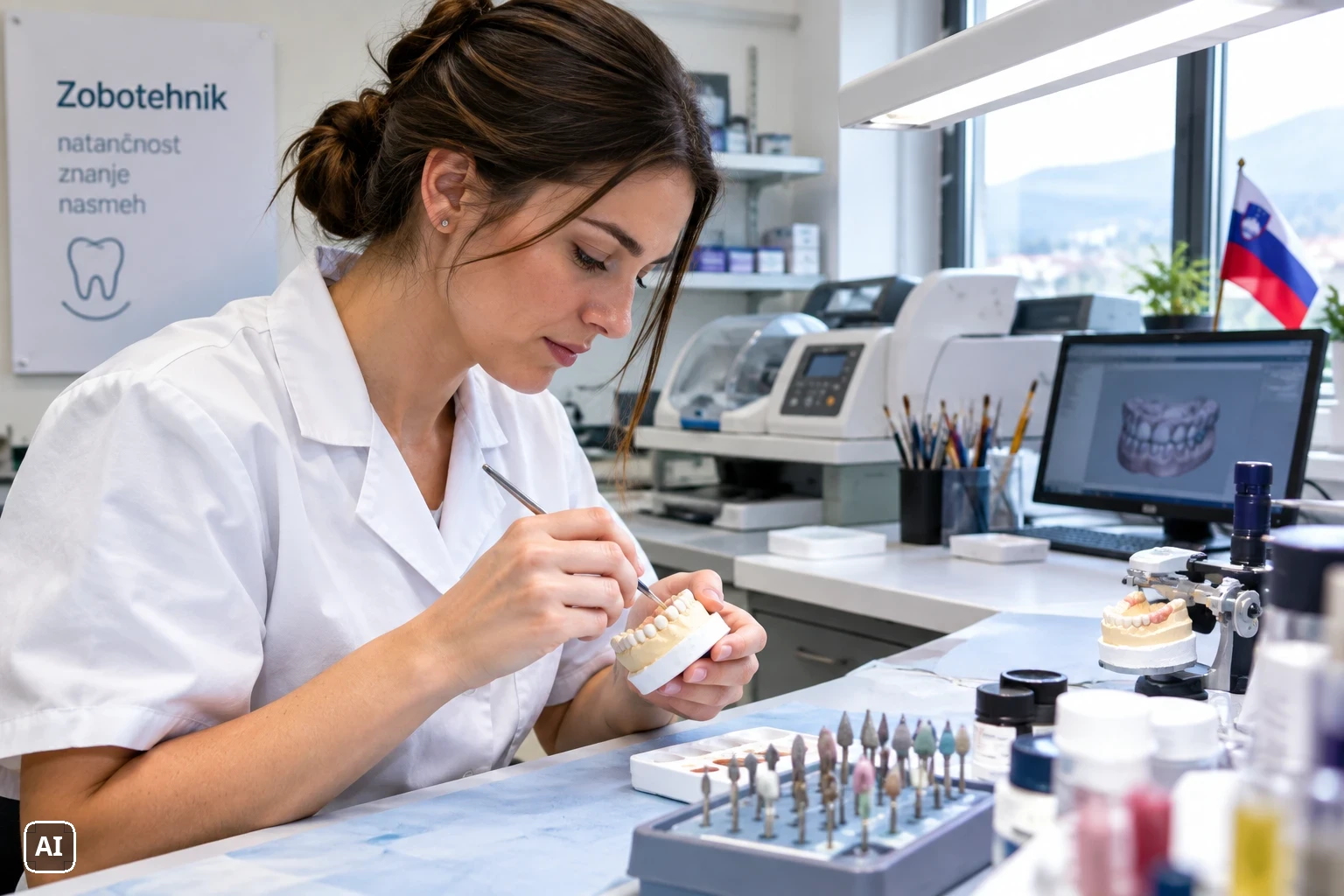
A dental technician is a healthcare worker who makes various dental restorations, prosthetic appliances and other dental technology products. The work is closely linked to dentistry, but a dental technician does not usually treat patients in the dental surgery. Instead, working from instructions, impressions, models, scans and other data, they produce dental appliances in a laboratory.
The profession combines healthcare knowledge, precise manual work, technology, aesthetics and design. Dental technicians work with a range of materials, instruments, machines and modern digital technologies, and CAD/CAM systems and 3D printing are becoming increasingly important.
In Slovenia, dental technician is a regulated healthcare profession. Before starting to practise, a dental technician must have the appropriate education and complete a traineeship and a professional examination.
Who is a dental technician?
A dental technician is a professional in the healthcare sector who makes dental and jaw restorations and other appliances used in dental and prosthetic treatment.
Their work is closely tied to the dentist, or doctor of dental medicine. The dentist assesses the condition of the patient’s teeth and oral cavity, makes the diagnosis and plans the treatment; the dental technician then makes the prosthetic product on the basis of the relevant data and the order.
A dental technician can work at the primary, secondary and tertiary levels of healthcare, and can also run a private healthcare practice under the conditions laid down by regulations.
What does a dental technician do?
The work is very precise and often requires several hours of concentrated effort. The main tasks include:
- making working models from impressions,
- making fixed prosthetic restorations,
- making removable dentures,
- making partial and complete dentures,
- individual modelling,
- making crowns and other prosthetic restorations,
- finishing and polishing prosthetic products,
- veneering with acrylic materials,
- making metal-ceramic frameworks,
- repairing dentures,
- relining dentures,
- working with dental technology materials,
- using a range of laboratory instruments and equipment,
- working with dentists and other members of the healthcare team.
Among other things, the official job description highlights making working models, fixed prosthetic restorations, individual modelling, acrylic dentures, metal-ceramic crowns, and denture repairs and relining.
Where does a dental technician work?
Dental technicians most often work in a dental laboratory. Employment is possible:
- in dental laboratories,
- in healthcare institutions,
- in dental institutions,
- in hospitals,
- in private dental laboratories,
- with private healthcare providers,
- in companies working in dental technology,
- in digital dental prosthetics,
- in making orthodontic and other dental appliances.
A dental technician can also run a private healthcare practice as a legal or natural person, provided they meet the prescribed conditions.
Education for dental technicians
When it comes to education, it is important to know that the programme has changed. The former upper secondary programme Dental Technician (Zobotehnik) has been replaced by the revised programme Dental Prosthetics Technician (Tehnik zobne protetike), which has been running since the 2023/2024 school year.
It is an upper secondary vocational programme that lasts four years and ends with the vocational matura. In the programme, students gain knowledge in areas such as:
- anatomy and physiology,
- morphology and gnathology,
- dental prosthetics,
- fixed prosthetics,
- removable prosthetics,
- special removable prosthetics,
- dental technology materials and technology,
- health protection,
- practical work,
- entrepreneurship and information technology.
The revised programme also includes content related to chairside assistance in the dental surgery.
→ Dental assistant: job description and employment
Where can you train as a dental technician?
In Slovenia, education for the current Dental Prosthetics Technician programme is linked mainly to health and dental technology education. One of the institutions that runs the programme is the Secondary School of Pharmacy, Cosmetics and Health Ljubljana (Srednja šola za farmacijo, kozmetiko in zdravstvo Ljubljana).
The programme lasts four years and ends with the vocational matura.
What do you have to complete after school?
Completing upper secondary vocational education does not in itself mean you can immediately practise the regulated profession of dental technician independently in healthcare. Before starting to practise, a dental technician must complete:
- the appropriate upper secondary vocational education,
- a traineeship,
- the professional examination.
According to SPOT, a six-month traineeship following the traineeship programme is prescribed for dental technicians. Its purpose is to gain practical experience and prepare for the professional examination and later independent work.
The professional examination for dental technicians
The professional examination is an important step towards independently practising a regulated healthcare profession. The Rules on traineeships and professional examinations for healthcare workers set out the traineeship requirements, the assessment of practical knowledge, and the conditions and content of the professional examination.
After successfully completing the traineeship and the professional examination, a dental technician can meet the conditions for independently carrying out professional tasks within the scope of their qualifications.
Is a dental technician a healthcare worker?
Yes. Dental technicians are classified as healthcare workers or healthcare associates for whom conditions for practising the profession are prescribed.
The official list of healthcare professions includes dental technician (zobotehnik/zobotehnica), which requires upper secondary vocational education, a traineeship and the professional examination. Dental technician is also listed among the regulated professions in Slovenia.
What is a dental technician’s working day like?
A dental technician’s working day can be very varied. In the morning they receive the orders or cases they need to make or finish. They then review the models, impressions, digital data or other information they need. The work may include:
- Preparing the model – first, they prepare or trim the model of the oral cavity.
- Planning the product – they decide on the right shape, materials and technological process.
- Making it – next comes modelling and making the framework or prosthetic product.
- Finishing – they trim, grind, polish, adjust and aesthetically finish the product.
- Quality control – before delivery they check the accuracy, function and appearance of the product.
- Working with the dentist – in more complex cases, communication and coordination with the dentist about the product is important.
Dental technicians and modern technology
The profession is developing rapidly in technological terms. Traditionally, the work relied heavily on manual modelling, plaster models, wax, metals, ceramics and acrylics. Today, the following are increasingly used:
- intraoral scans,
- digital models,
- CAD software,
- CAM systems,
- computer-aided prosthetic design,
- 3D printing,
- digital fabrication of frameworks,
- modern ceramic materials,
- zirconia,
- digital smile design and prosthetic solutions.
A modern dental technician therefore combines manual skills with digital competences.
What does a good dental technician need to know?
Above all, a good dental technician needs precision. Important qualities are:
- very good fine motor skills,
- precision,
- patience,
- a sense of aesthetics,
- good eyesight,
- a sense of colour,
- spatial awareness,
- technical thinking,
- the ability to concentrate,
- responsibility,
- independence,
- organisation,
- willingness to learn new technologies,
- the ability to work in a team.
A feel for shape and aesthetics is particularly important, as dental restorations should look as natural as possible.
Manual skills matter a great deal
In this profession, manual dexterity is one of the key competences. Dental technicians work with small and very precise structures. A small error can affect the fit, function or appearance of a prosthetic product. At work, a dental technician must therefore be:
- calm,
- precise,
- patient,
- consistent.
The work can suit people who enjoy creating, modelling, designing and working with small objects.
Dental technicians and patients
A dental technician does most of their work in the laboratory and usually has less direct contact with patients than a dentist. Their work, however, has a direct impact on the patient. The final product must be:
- functional,
- accurate,
- suitable for the patient,
- aesthetically appropriate,
- made in line with the order and professional requirements.
A dental technician must therefore also understand the patient’s basic needs and the importance of good-quality prosthetic rehabilitation.
The difference between a dental technician and a dentist
The dental technician and the dentist have different roles.
The dentist, or doctor of dental medicine
- examines the patient,
- makes the diagnosis,
- plans the treatment,
- carries out dental procedures,
- works with the patient,
- decides on or orders prosthetic solutions.
The dental technician
- works mainly in the laboratory,
- makes dental restorations,
- makes dentures and other prosthetic products,
- uses a range of materials and technologies,
- works with the dentist,
- is responsible for the technical and aesthetic execution of the ordered product.
A dental technician is therefore not a dentist. These are two different professions with different educational paths and competences.
→ Dentist – doctor of dental medicine: job description and specialisations
Dental technician or dental prosthetist?
These two titles can also cause confusion. Dental technician is a regulated healthcare profession requiring upper secondary vocational education, a traineeship and the professional examination. Dental prosthetist (zobni protetik) is a separate regulated profession with different requirements for education and competences.
A dental technician mainly carries out dental technology procedures, while a dental prosthetist represents a higher level of professional qualification in dental prosthetics.
Specialist skills of dental technicians
Dental technicians can continue their training and develop specialist skills. In the Slovenian system, the areas of special knowledge include, for example:
- orthodontics,
- metal-ceramic technique,
- metal-free ceramic technique,
- zirconia,
- combined work and milling,
- implantology,
- CAD/CAM systems.
For the post of dental technician with special knowledge, the collective agreement has also listed a special qualification or specialist course in one of these areas as an appropriate basis.
Employment of dental technicians in Slovenia
Dental technicians can work in a variety of settings. The most common employers are:
- dental laboratories,
- healthcare institutions,
- hospitals,
- dental institutions,
- private laboratories,
- companies in the dental industry.
Self-employment or a private practice is also possible if all the prescribed conditions are met.
Dental technician pay in Slovenia
A dental technician’s pay depends on:
- education,
- work experience,
- additional skills,
- the type of post,
- the area of work,
- the employer,
- the region,
- whether the job is in the public or private sector,
- the complexity of the products,
- knowledge of digital technologies.
For dental technicians with additional skills, the posts and pay grades can also differ. With public employers, pay is linked to the public sector pay system; in private laboratories, conditions depend on the employer and the employment contract.
There is therefore no single “dental technician salary”.
Advantages of the profession
The advantages of the profession can include:
- creative work,
- a lot of precise manual work,
- a combination of medicine and technology,
- the chance to work with modern technology,
- opportunities for further professional training,
- the possibility of working in the private sector,
- the possibility of self-employment,
- work in a dental laboratory,
- visible results of your own work.
It is particularly interesting for people who, alongside healthcare, are also interested in technology, design, aesthetics and digital technologies.
Disadvantages and challenges of the profession
The profession also has its challenges. The work can be:
- very precise,
- time-consuming,
- demanding on the eyes,
- a strain on the hands and posture,
- time-limited by deadlines,
- demanding because of small errors,
- linked to various materials and laboratory procedures.
A dental technician must also be prepared for the field to keep changing technologically.
Is being a dental technician hard?
The profession requires a combination of professional knowledge, practical skills and great precision. For some people, the biggest challenge is working with very small structures, sustained concentration and the need to follow instructions exactly.
On the other hand, the work can be very rewarding, as a dental technician creates a tangible product that is later used by a patient.
Dental technicians and the future of the profession
Dental technology is changing rapidly with the development of digital dentistry. In future, knowledge in the following areas will be particularly important:
- digital design,
- CAD/CAM technology,
- 3D printing,
- digital impressions,
- new prosthetic materials,
- implant prosthetics,
- orthodontic appliances,
- computer-aided manufacturing.
This means that traditional manual work is not disappearing but is increasingly combined with digital technologies. The modern dental technician is therefore a combination of healthcare worker, technician, designer and digital specialist.
Can a dental technician start their own business?
A dental technician can run a private healthcare practice, but must meet the conditions laid down by healthcare regulations. For a private practice, the following are particularly important:
- appropriate professional qualifications,
- suitable premises,
- suitable equipment,
- meeting the conditions for providing healthcare services,
- registration of the business,
- meeting other legal requirements.
SPOT explicitly states that dental technicians can run a private healthcare practice as legal or natural persons.
Is dental technician a regulated profession?
Yes. Dental technician is a regulated profession in Slovenia. This means that the conditions for practising it are set by regulations. Among other things, these cover:
- the required education,
- the traineeship,
- the professional examination,
- the conditions for recognising foreign professional qualifications,
- the conditions for cross-border or temporary practice.
The competent authority for the profession is the Ministry of Health.
Dental technicians from abroad
If a person obtained their professional qualification in another EU country, a procedure for recognising the professional qualification is prescribed before they can practise in Slovenia. For dental technicians, SPOT lists the general system of recognition.
The profession can also be practised in Slovenia on a cross-border or temporary basis, but the appropriate authorisation must be obtained before practising for the first time.
Frequently asked questions about the dental technician profession
What is a dental technician?
A dental technician is a healthcare worker who makes dental restorations, dentures, prosthetic frameworks and other dental technology products.
Which school do you need to finish to become a dental technician?
You need the appropriate upper secondary vocational education. The current programme is called Dental Prosthetics Technician and has replaced the former Dental Technician programme.
How many years does the training take?
The upper secondary vocational programme lasts four years and ends with the vocational matura.
Does a dental technician have to complete a traineeship?
Yes. Before starting to practise, a dental technician must complete a traineeship and the professional examination.
How long is the traineeship?
A six-month traineeship is prescribed for dental technicians.
Is a dental technician a healthcare worker?
Yes. Dental technician is one of the regulated healthcare professions.
Does a dental technician work with patients?
Most of the work is done in the dental laboratory. As a rule, a dental technician has less direct contact with patients than a dentist.
Does a dental technician make dentures?
Yes. Their tasks include making partial and complete acrylic dentures and other prosthetic restorations.
Does a dental technician make crowns and bridges?
Yes. Their work also includes making fixed prosthetic restorations.
Can a dental technician work privately?
Yes. If they meet the prescribed conditions, they can run a private healthcare practice.
Can a dental technician continue their education?
Yes. After upper secondary vocational education and the vocational matura, there are various paths to further education, depending on the admission requirements of each programme.
Dental technician – a short summary
A dental technician is a healthcare worker who makes dental restorations and other prosthetic products in a dental laboratory. The profession calls for:
- upper secondary vocational education,
- practical and manual skills,
- precision,
- a sense of aesthetics,
- a traineeship,
- the professional examination,
- knowledge of dental technology materials,
- keeping up with developments in digital technology.
The former Dental Technician programme has been replaced by the Dental Prosthetics Technician programme, which has been running since the 2023/2024 school year. The regulated profession itself, however, is still officially listed as dental technician (zobotehnik/zobotehnica).
The profession suits people who are interested in healthcare, dental prosthetics, technology, design, aesthetics and very precise manual work.
DENTAL TECHNICIAN JOBS (see current vacancies for dental technicians)
ARE YOU HIRING A DENTAL TECHNICIAN? (see the packages for posting a job advert)
What is a BOOST advert? Read more …
All healthcare and pharmacy professions in one place
Have you found an error in this description, or does it need updating? Please send corrections to: podpora@zdravstvena.info
Sources and useful links
- SPOT – Dental technician: official information on the conditions for practising the profession, the traineeship, the professional examination and private practice.
- List of healthcare professions: dental technician as a profession requiring upper secondary vocational education, a traineeship and the professional examination.
- Rules on traineeships and professional examinations for healthcare workers: traineeship requirements and the content of the professional examination.
- Upper secondary programme Dental Prosthetics Technician: the revised programme running since the 2023/2024 school year.
- Secondary School of Pharmacy, Cosmetics and Health Ljubljana: provider of the Dental Prosthetics Technician programme.
- Collective agreement for healthcare and social care: the post of dental technician with special knowledge.