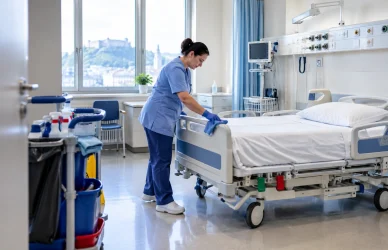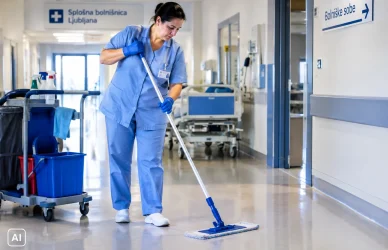


The nurse at secondary level — in Slovenia officially the nursing technician, »tehnik zdravstvene nege« — is a regulated healthcare profession. The qualification comes from a four-year upper secondary technical programme ending in the vocational matura. The work covers delivering nursing care within the competences acquired, helping patients with the activities of daily life, carrying out procedures as instructed, observing and reporting on the patient’s condition, and working within the nursing team. Employment is possible in hospitals, community health centres, care homes for older people, social care institutions, private practices, health resorts and long-term care. Independent work in healthcare activity requires a professional examination and entry in the register of providers in nursing and midwifery care — a licence is not required for this profession.
Why »nurse« and »nursing technician« are not two names for the same thing
This is the most common misunderstanding about the profession, so let us clear it up straight away.
In everyday speech people call anyone in a nurse’s uniform a nurse. Within the health system, however, these are two different professions with different education, different competences, different responsibility and different pay:
- the nursing technician — formerly the »secondary-level nurse«: upper secondary technical education, a member of the nursing team;
- the registered nurse: professional higher education, the person who carries nursing care and leads the team.
This article is about the first. We have written about the second separately.
→ Registered nurse: job description, licence, pay and employment
The nursing technician in brief
The profession:
- is regulated,
- is gained through a four-year upper secondary technical programme,
- requires a professional examination,
- requires entry in the register of providers in nursing and midwifery care,
- does not require a licence (that is prescribed for the registered nurse, the registered midwife and the higher-level nurse),
- is practised at the primary, secondary and tertiary level of healthcare activity,
- is present in healthcare, social care and long-term care.
What does a nursing technician do?
The work is carried out within the competences acquired and inside a nursing team led by a registered nurse. That is not a matter of mistrust; it is how nursing care is organised — someone plans it and answers for it, someone delivers it at the bedside.
In everyday work this most often means:
- delivering nursing care within their competences,
- helping the patient with the activities of daily life,
- personal hygiene, making the bed and the patient’s comfort,
- helping with movement and transfers,
- helping with eating and drinking,
- measuring and recording vital signs,
- carrying out procedures as instructed and within competence,
- preparing the patient and the equipment for tests and procedures,
- assisting during procedures,
- hygiene of the working environment and of equipment,
- documenting the work done,
- observing the patient and reporting changes,
- communicating with the patient and the family,
- working with the registered nurse, the doctor and the rest of the team.
Observation matters more here than it sounds. The nursing technician is often the person who spends the most time at the bedside and is therefore first to notice that something is wrong — that breathing has changed, that the patient has drunk nothing, that a wound looks different from this morning. Passing that on in time to the registered nurse or the doctor is part of the safety of the whole treatment.
Important: the exact scope of competences is set by the occupational standard, by legislation and by the employer’s instructions, and these can change. For any specific post, always check what it covers.
Which competences does a nursing technician need?
Professional knowledge
The basics of anatomy, physiology and pathology, nursing care, hygiene, infection prevention, patient safety and first aid.
Precision
In measuring, recording, preparing equipment and documenting. An error in the record can matter as much as an error in the procedure.
Observation and reporting
Recognising a change and passing it to the right person in time.
Teamwork
This profession barely exists on its own. Working in step with the registered nurse, the other technicians and the hospital orderlies is what keeps a ward running.
Physical resilience
A great deal of walking and standing, moving patients, shift work.
Communication and patience
Patients are often frightened, confused or in pain, and families can be impatient. Calm, respectful conduct is part of the job.
Where can a nursing technician work?
Hospitals
Wards, the operating block, emergency departments, intensive nursing, specialist clinics.
Community health centres
General and specialist clinics, dispensaries, vaccination, health education, the ambulance service.
Care homes and social care institutions
One of the largest areas of employment: nursing care of residents, long-term care, palliative and supportive care.
Private providers and health resorts
Private clinics, specialist centres, rehabilitation and spa services.
Long-term care and home help
A field that is developing in Slovenia and opening posts outside the classic hospital.
→ Nursing technician: current vacancies
How to become a nursing technician
The route is shorter and more direct than for a registered nurse.
- Enrol in the upper secondary technical programme in nursing care after basic school.
- Four years of study, including extensive practical training in healthcare and social care institutions.
- Finish with the vocational matura and gain the title of nursing technician.
- A traineeship or the prescribed induction period and the professional examination.
- Entry in the register of providers in nursing and midwifery care.
After the vocational matura, further study is possible — most often the professional higher education programme in nursing, which leads to the title of registered nurse.
Important: entry conditions, the scope of the programme and the conditions for practising can change. Check the current information from the school and the competent authorities before deciding.
Nursing technician or registered nurse?
| Nursing technician | Registered nurse |
|---|---|
| upper secondary technical programme, 4 years | professional higher education |
| vocational matura | first-cycle degree |
| member of the nursing team | carries nursing care |
| delivers nursing care within competence | plans, leads and evaluates nursing care |
| works in a team led by a registered nurse | leads the nursing team |
| professional examination and register | professional examination, register and licence |
| pay group E, lower range of pay grades | pay group E, higher range of pay grades |
Both professions are necessary, and neither works without the other. The difference lies in the scope of education, competences and responsibility — not in who is “better” or who works harder.
Nursing technician or hospital orderly?
These are not the same either. The hospital orderly helps with nursing care and with basic daily activities; their education lasts three years and their scope of competence is narrower. The nursing technician has four years of upper secondary technical education and a wider range of tasks.
→ Hospital orderly: job description and employment
How much does a nursing technician earn?
In public healthcare, posts for nursing technicians sit within the public sector pay system, among healthcare workers in pay group E. The exact pay grade differs according to the post and the field of work — intensive nursing, an outpatient clinic and a care home are not valued the same way.
Slovenia introduced a new pay system on 1 January 2025, with entitlements acquired gradually; the government states that the reform runs from 2025 to 2028. A pay grade is therefore not the same as the amount that reaches a bank account.
Final earnings are also shaped by:
- the length-of-service allowance,
- allowances for shift, night and public holiday work,
- allowances for special working conditions,
- work performance,
- promotions,
- overtime.
Allowances matter here, because shift work is the rule rather than the exception.
In the private sector there is no single state pay scale; pay depends on the employer, the field of work, experience and the range of tasks.
You will not find a single figure in this article presented as “a nurse’s salary”. The gap between a newly qualified technician in an outpatient clinic and an experienced one in intensive nursing with night shifts and twenty years of service is too large to be honestly reduced to one number. For any specific advert, check the post, the field and how the work is organised.
Who does the profession suit?
It can suit someone who:
- wants to gain a qualification and start working relatively quickly,
- is interested in healthcare and in working with people,
- is precise and reliable,
- can work in a team,
- is physically resilient,
- can cope with shift work,
- stays calm when things go wrong,
- is considering further study in nursing.
For many people this is the first step: four years of secondary school and a job first, then a nursing degree, full time or alongside work.
How demanding is the work?
Honestly, it is demanding:
- shift work, night shifts, weekends and public holidays,
- a great deal of walking and standing,
- lifting and moving patients,
- staffing pressures and working against the clock,
- contact with serious illness, dying and the distress of families,
- responsibility for carrying out procedures precisely.
On the other hand, it is work where a person can see exactly whom they helped — and that is the most common reason people stay in it.
The future of the profession
An ageing population
According to the EUROPOP2025 projections published for Slovenia by the Statistical Office (SURS), the share of the population aged 65 or over is expected to rise as follows:
| Year | Share of the population aged 65 or over |
|---|---|
| 2030 | 24.2 % |
| 2040 | 27.4 % |
| 2050 | 30.3 % |
| 2060 | 31.0 % |
The share of people aged 80 or over is projected to reach 10.9 % by 2050. An older population means more chronic illness, more hospital stays and far more long-term care — in other words, more nursing care at the bedside.
What the labour market says
In its Occupational Barometer for 2026, the Employment Service of Slovenia lists doctors, nursing professionals, physiotherapists, dentists and hospital orderlies among the occupational groups in short supply.
That overview does not publish a separate forecast for nursing technicians, so it cannot be claimed that they are forecast to be in shortage. It does show the wider picture: Slovenian healthcare and social care already record significant staffing needs in nursing and care.
Long-term care
The development of long-term care is opening posts outside the hospital — in care homes, home help and community care.
Digitalisation and artificial intelligence
Part of the documentation, scheduling and data monitoring will be automated, which makes digital skills increasingly important. What technology does not replace is the part of the work that happens at the bedside — washing, transferring, feeding, talking, noticing that something is not right. The likelier outcome is that it changes how the work is done.
Career options
- narrower clinical fields (operating block, intensive nursing, emergency, dialysis, oncology),
- long-term care and care of older people,
- the ambulance service,
- further study in nursing leading to the title of registered nurse,
- after graduation, a master’s degree and narrower clinical fields,
- mentoring students on placement,
- work abroad.
→ Registered nurse: current vacancies
→ Master of nursing: current vacancies
Where to look for work
It is worth following hospitals, community health centres, care homes for older people, social care institutions, private providers, health resorts and long-term care providers.
Employers do not always use the same job title, so search under several terms:
- nursing technician,
- nurse,
- tehnik zdravstvene nege,
- medicinska sestra,
- srednja medicinska sestra.
It is also worth searching by place — for example Ljubljana, Maribor, Celje or Koper.
What to check before accepting a job
- the field and type of ward,
- the ratio of patients to staff,
- how shifts and night work are organised,
- the make-up of the nursing team,
- the induction period and mentoring,
- who leads the nursing team and how reachable they are,
- allowances and how overtime is calculated,
- equipment and aids for moving patients,
- opportunities for training and for studying alongside work.
For someone coming straight from school, the most important question is about mentoring: will they spend the first months working alongside someone experienced?
Frequently asked questions
Are »nurse« and »nursing technician« the same profession?
Yes. »Nursing technician« is the current official title in Slovenia for the profession once called the »secondary-level nurse«. In everyday speech people simply say nurse.
Are a nursing technician and a registered nurse the same profession?
No. They are two different professions: the nursing technician holds upper secondary technical education and is a member of the nursing team, while the registered nurse holds professional higher education, carries nursing care and leads the team. They also differ in responsibility and in their place in the pay system.
What education is required?
A four-year upper secondary technical programme in nursing care, completed with the vocational matura.
Is the profession regulated?
Yes. The nursing technician is listed among the regulated healthcare professions under the Ministry of Health.
Does a nursing technician need a licence?
No. The profession requires a professional examination and entry in the register of providers in nursing and midwifery care. A licence is prescribed for the registered nurse, the registered midwife and the higher-level nurse.
How much does a nursing technician earn?
Pay depends on the sector, the post, the field of work, length of service, allowances and shift arrangements. In the public sector the posts sit in pay group E, while the new pay system is being introduced gradually up to 2028.
Can a nursing technician study further?
Yes. After the vocational matura it is possible to enrol in the professional higher education programme in nursing, which leads to the title of registered nurse.
Will the profession be in demand in the future?
The precise number of posts cannot be predicted, and the Employment Service does not publish a separate forecast for nursing technicians. SURS demographic projections and the development of long-term care do point to a rising need for nursing and care.
Who is the profession suited to?
People interested in healthcare and in working with others, who are precise, reliable, physically resilient and ready for shift work — and often those who want a qualification first and a decision about further study later.
Conclusion
The nursing technician is the profession that holds nursing care together where it actually happens: at the bedside. It is not a shorter version of the registered nurse, but a profession of its own, with its own education, competences and responsibility.
It is demanding, it works in shifts and it is physically hard. It is also a relatively quick route into healthcare employment and, for many people, the first step on a path that can continue with a nursing degree.
Demography, the development of long-term care and the state of healthcare all point the same way: there will not be less work at the bedside.
NURSING TECHNICIAN JOBS (see current vacancies for nursing technicians)
ARE YOU HIRING A NURSE? (see the packages for posting a job advert)
What is a BOOST advert? Read more …
All healthcare and pharmacy professions in one place
Have you found an error in this description, or does it need updating? Please send corrections to: podpora@zdravstvena.info
Official and professional sources
- SPOT – regulated healthcare professions under the Ministry of Health: conditions, professional examination, register and licence.
- Ministry of Health – Healthcare Workforce Division.
- SURS – EUROPOP2025: population projections for Slovenia.
- Employment Service of Slovenia – Occupational Barometer 2026: occupational groups in short supply.
- GOV.SI – the public sector pay system and its gradual introduction between 2025 and 2028.