
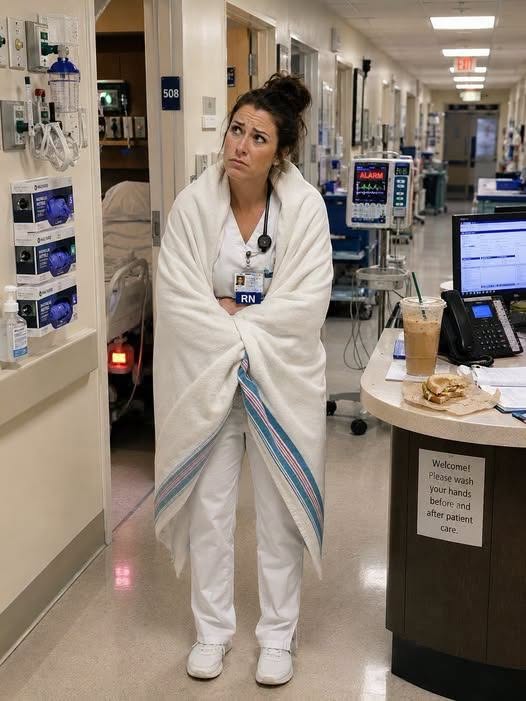
… you can tell exactly which infusion pump is alarming just by the sound, even before you look at it.
… you hear an alarm coming from a hospital room while you’re in a store and instinctively turn around.
… you can recognize a medication just by the shape of its packaging, before you even read the name.
… you can tell from a relative’s facial expression that a question is coming that will last the next twenty minutes.
… in every room you enter, you unconsciously look for oxygen, a suction device, and gloves first.
… you can eat an entire meal in four minutes and then have no idea what it even tasted like.
… you walk into a room and completely forget why you came in. As soon as you walk out, of course, you remember.
… at home, you hear a strange sound and for a moment wonder which machine is alarming.
… someone says, “It only hurts a little,” and your brain is already unconsciously checking all the possible scenarios.
… you know how to stay calm in the most difficult moments, even when you are exhausted yourself.
… you know how to make other people feel safe, even when you are the one who needs that feeling most.
And perhaps that is something you don’t realize enough as the years go by.
Working in healthcare doesn’t just change your schedule. It doesn’t just change your habits. Little by little, it also reshapes the way you think, observe, and experience the world.
You become attentive to things that other people don’t even notice. You learn to listen to silence, recognize a look, catch a change in someone’s voice, and notice something that at first glance might not seem important at all.
You become someone who can switch from exhaustion to quick action within seconds when someone needs help.
And yes, sometimes because of that, even while on vacation you still find yourself unconsciously watching the people around you.
But behind all of this is something much deeper.
Behind every quick reaction, every alarm, every sleepless night, and every “I’ll just do this one more thing” stands a human being.
A person who takes care of others.
A person who is often tired, but comes back again the next day.
A person who may have heard the same alarm a thousand times, yet still gets up and goes to check.
This is the life of healthcare workers. And after a certain amount of time, you realize that your job is no longer just something you do. It becomes part of who you are.
Now it’s your turn. 🏥🤩🫵👇
What habits, reactions, or situations from work have you carried over into everyday life?
Which statement do you think absolutely should be added to this list?
Write your thoughts, experiences, and your most relatable “You know you’ve been a healthcare worker for too long when…” statements in the comments. Original thread: https://www.facebook.com/photo/?fbid=1491931066311029&set=a.557040439800101
Collected statements from healthcare workers:
Vesna Bradeško:
I hear far too well… I notice every sound… I already anticipate what will happen and what could happen. Basically, I’m annoying to what we might call “normal people.” Oh yes, there would be plenty more to add… but that’s what 46 years of working in intensive care have done to me. Still, this job of mine — or second home — was a beautiful one… sad… happy… exhausting… I would never have chosen another path.
Tanja Malić:
When you need a pencil or scissors, you reach into your pocket even though you’re somewhere in civilian clothes and not at work. 😅 Same thing when your phone rings in a store and you think it’s your pager. 😅 The worst is when you answer your personal phone and say which hospital department you’re calling from.
Sandra Manny Gabrič:
I think my granddaughters will have all their food cut into tiny pieces until they’re 18, so none of them choke. I work in a nursing home with elderly people. Especially grapes — every single one cut in half.
Sašo Fujs:
You know you’re a healthcare worker when, at a traffic accident, you don’t grab your phone and start filming, but go to help. When you see someone on the road who has difficulty walking, you feel compelled to help them.
Špela Zajc:
Whenever I’m at home and someone sleeps too long, I go check whether they’re still breathing… I just have to go and check. 🥺😳🤦♀️ My daughter tells me, “Mom, you see something dangerous in everything…”
Milena Rogelj:
Just like those before me… at home, back when we still had a landline, I answered the phone, “C Ground Floor, please.” And the voice on the other end replied, “How many floors do you have there?”
Watching the people around you also gets under your skin. When you’re standing in line at a store, you automatically notice trembling hands, a gray or yellowish complexion, painful movements when someone walks… and you wonder what might be wrong with the person.
Marjeta Mlakar:
Being a healthcare worker isn’t just a profession; it’s a calling. And it isn’t just your calling — it becomes the calling of your entire family. You always put your profession before your family. When the on-call phone rings, you jump up and leave your family behind. They’ll manage; they’re used to it… and you rush off because someone who is sick needs you more. My family accepted and respected my calling for 40 years. Now that I’m retired, I finally see how much I deprived them of and how much they gave me by accepting my priorities. Grateful from the bottom of my heart.
Once you become a nurse, you are one for life. ❤️
Lilijana Leban:
It is so true; in certain situations you always see the end scenario, while others usually say, “Yes, but what if…” I think we always think it’s better to prevent something before it happens… although we usually don’t apply that to ourselves, at least not enough.
You subconsciously observe more, notice how your loved ones are feeling earlier and more intensely than others do. And there’s more. These are just some of the consequences of our profession, which can sometimes be annoying for those close to us. And I tell myself: lucky are those who have no idea about any of this.
Lucija Vitrih:
When you come home from a night shift, fall into bed, finally fall asleep, think you hear the call bell, jump up… and realize you’re at home. 😅
Žiga Kogej:
When you can recognize every bit of pain on a family member’s face. That’s how I discovered my son had an inguinal hernia before I even took him to the doctor and for an ultrasound. I also recognized a ruptured gallbladder in my stepfather; quick action saved his life. And when your wife calls and you answer, “AMBULANCE 02, PLEASE?”
Nina Žvab:
Thank God we’re like this. Praise and respect to everyone. ❤️
Špela Godeša:
Respect to everyone working in healthcare, and a huge THANK YOU. 💕
Maja Kukman:
You guys are amazing!!!!! Hats off to anyone who does this job. 😊
Jana Korinšek:
When you answer the phone at home and say, “Operating room, please…”
Romina Barbara Habič:
When I answer my personal phone: “Cardiology, please…”
Bojana Fid:
When I moved from a clinical setting to a specialist outpatient clinic in the same field, it took me quite a while to stop answering the phone with, “Intensive Care, please…” Oops…
And if anyone complains about anything, I have 1,000 scenarios running through my head… hmmm 🥰✨🤗🌸❤️
Our calling is wonderful, and I do my work the way I would want others to do it if I were — or ever am — in the role of a patient.
Although we all know that isn’t always the case…
With a great deal of professionalism, empathy, and respect for everyone…
Valerija Aršič:
Some of you really are gods in white/blue, whatever color the clothes you wear at work happen to be… at least all of you who have written here. Unfortunately, not everyone is like that.
Tanja Stržinar:
You hear tachycardia on a monitor, around 180, and say out loud, “Which monitor is that? Why isn’t there an alarm?”
A moment later, your husband wakes you up: “You’re talking in your sleep…” And then you hear your radio alarm clock playing music, with a drum rhythm of 180 beats per minute.
That’s when you realize it’s time to change jobs.
Simona Stopar:
At home I walk around in the dark, with the bedroom doors open, listening to my family member’s breathing. And when there’s a full moon, I’d rather not even talk about it — three days before and three days after are the same…
What wears me down the most is constantly talking about illness, the hospital, and medications… sadly.
Tanca Taca:
Sleeping after a night shift is restless because every sound wakes me up.
I also eat Sunday lunch in five minutes, so I no longer even know what sharing a meal together means.
I have grown-up children, and they don’t remember bedtime stories, and Sunday outings were short because sometimes I was on call.
Maja Uštar:
…I’m cooking, take scissors out of the drawer, and put them in the upper-left pocket of my shirt… 🤪🤣 Of course, they fell on the floor. 🫣
Saša Watzak:
I often hear the call bell even when I’m at home. 😄
Vesna Hrženjak:
“You know you’ve been a healthcare worker too long when…” Never! You can never be a healthcare worker for too long! You are a healthcare worker forever. That’s what you chose, and it’s the most beautiful profession in the world!
Marina Mesaric:
When you have Leukoplast at home instead of regular Scotch tape. 🤣
Roberto Markežič:
Professional deformation: when you hear a sound in a store that you recognize from work. Sadly, but thank you for all your hard work with patients. ❤️
Veronika Turk:
Hello. After a night shift, during the day I still hear the call bell in my ears.
Bojan Černuta:
Exactly.
Karmy Janežič:
How true all of this is… ♥️
Darinka Štrukelj:
When you enter a store and say, “Next, please…”
Lidija Grah:
Yes, you answer the phone at home and introduce yourself as if you were at work… then, “Ohhhh…” And everything mentioned above is so true.
Barbara R. Zadnik:
At the beach, you look at people’s legs and neck veins. 🙈
Marjanca Grašič:
My respect for what was written. I worked in healthcare for 41 years…
Tina Kocjan:
I look at everyone’s feet — what shoes they’re wearing, how they walk, and how damaged their spines are. 🙈